LGBTQ Social Movements by Lisa M. Stulberg
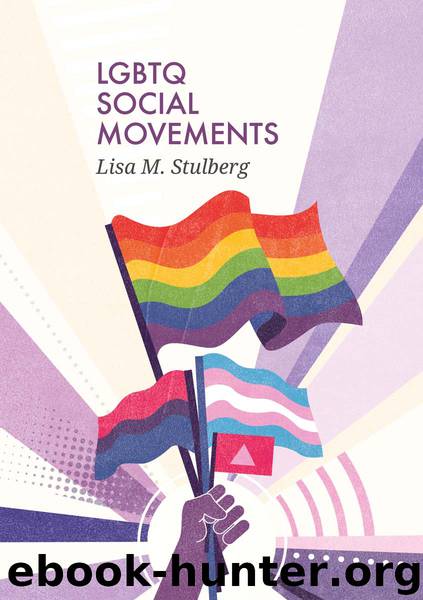
Author:Lisa M. Stulberg
Language: eng
Format: epub
ISBN: 9781509527403
Publisher: John Wiley & Sons, Inc.
Published: 2018-01-22T00:00:00+00:00
After Marriage
When the nationwide marriage win was in sight, activists, writers, and a number of the mainstream LGBTQ civil rights groups began to ask: what comes next (see, e.g., Montgomery, 2015)? The HRC, for instance, published a lengthy report called Beyond Marriage Equality, which made a case for a focus on broad nondiscrimination laws concerning employment, housing, education, and public accommodations, among other domains. The report highlighted that only 18 states plus the District of Columbia have laws that explicitly prohibit public and private employment discrimination on the basis of sexual orientation and gender identity. Three additional states bar discrimination by sexual orientation but do not include gender identity as a category to protect transgender employees (HRC, 2015, p. 31).25 There is, as of yet, no clear federal protection against workplace discrimination (Wolf, 2017). There has been some recent attention paid to the fact that LGBTQ nondiscrimination laws are not just a feature of large or coastal cities. One March 2017 analysis found that of the approximately 50 towns and cities that adopted nondiscrimination laws since 2015, all were in states that handed Donald Trump a victory in November 2016, and more than half had populations of 35,000 people or fewer (Stein, 2017).
Others, looking to a time when the marriage fight would be over, added that transgender rights should be a new priority in the broader LGBTQ movement (see, e.g., Capehart, 2015; Yoshino, 2015). Some on the Left called for the continued advocacy of a more liberationist agenda, one that would not rely on the state for the granting of justice and would celebrate difference and queerness, specifically (e.g., Stein, 2015). Historian Timothy Stewart-Winter (2015) wrote in the New York Times that queer people should leverage their historical role as outsiders for further social change – like trans rights, support for homeless youth, and Black Lives Matter – rather than abandoning this status once the marriage door had been fully opened: “Betraying our history – forgetting what it has meant to be gay – would be a price too high to pay” (n.p.). Some have urged, simply, that the marriage victory does not mean it is time to pack up the movement and go home to new spouses. Signorile argues that activists and optimistic community members suffered from “victory blindness”: “the dangerous illusion that we’ve almost won” (2015, p. 1).
It remains to be seen where the LGBTQ civil rights movement will next put its energy and resources and how it will connect with the more radical, liberationist strand of the movement or with groups that focus specifically on intersectional identities. We can see, however, that marriage politics are exemplary of the longstanding tensions between liberationists and assimilationists (Ghaziani et al., 2016) and of the longstanding politics of privilege.
Marriage is a necessary civil rights gain. You cannot be free if you do not have the self-determination to love and partner and build a family. There is also some recent research that shows that the very existence of marriage equality laws may
Download
This site does not store any files on its server. We only index and link to content provided by other sites. Please contact the content providers to delete copyright contents if any and email us, we'll remove relevant links or contents immediately.
| Anthropology | Archaeology |
| Philosophy | Politics & Government |
| Social Sciences | Sociology |
| Women's Studies |
Nudge - Improving Decisions about Health, Wealth, and Happiness by Thaler Sunstein(7762)
The Fire Next Time by James Baldwin(5508)
iGen by Jean M. Twenge(5467)
Adulting by Kelly Williams Brown(4623)
The Sports Rules Book by Human Kinetics(4453)
The Hacking of the American Mind by Robert H. Lustig(4427)
The Ethical Slut by Janet W. Hardy(4311)
Captivate by Vanessa Van Edwards(3867)
Mummy Knew by Lisa James(3730)
In a Sunburned Country by Bill Bryson(3588)
The Worm at the Core by Sheldon Solomon(3515)
Ants Among Elephants by Sujatha Gidla(3495)
The 48 laws of power by Robert Greene & Joost Elffers(3383)
Get What's Yours for Medicare: Maximize Your Coverage, Minimize Your Costs by Philip Moeller(3109)
Suicide: A Study in Sociology by Emile Durkheim(3046)
The Slow Fix: Solve Problems, Work Smarter, and Live Better In a World Addicted to Speed by Carl Honore(3040)
The Tipping Point by Malcolm Gladwell(2967)
Humans of New York by Brandon Stanton(2910)
Handbook of Forensic Sociology and Psychology by Stephen J. Morewitz & Mark L. Goldstein(2742)
